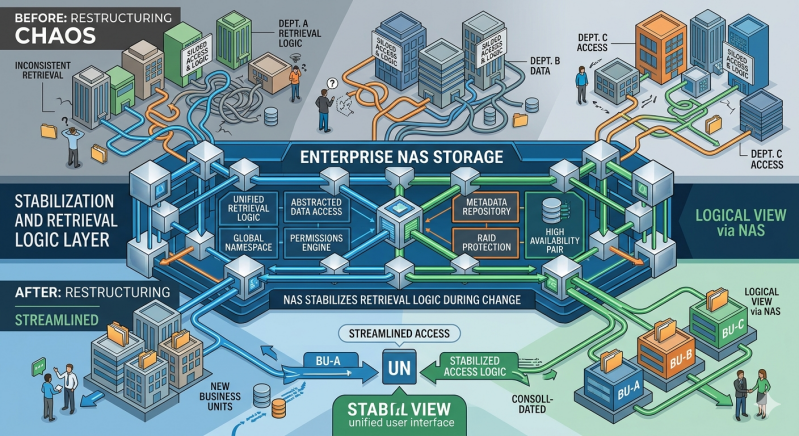
Organizational data restructuring introduces significant operational risks. When IT departments consolidate data centers, migrate workloads, or rearchitect digital environments, the underlying physical locations of files shift. This movement threatens existing retrieval logic, which relies on specific programmatic pathways and queries applications use to access required data. Broken file paths lead to application failures, processing bottlenecks, and critical downtime.
To mitigate these risks, systems architects rely on Enterprise NAS Storage. By decoupling the logical data access paths from the physical storage hardware, organizations can maintain uninterrupted operations. This article explains the technical mechanisms by which Network Attached Storage frameworks stabilize retrieval logic, ensuring that critical applications continue to function seamlessly even as the backend storage environment undergoes extensive restructuring.
The Impact of Restructuring on Data Retrieval
When an organization executes a data restructuring initiative, the primary objective is often to optimize resource utilization, reduce latency, or meet new compliance standards. However, the execution phase fundamentally disrupts the environment. Applications are typically hardcoded or configured to expect data volumes at specific IP addresses or directory structures. When data migrates to new servers or cloud repositories, the retrieval logic breaks.
Database queries, automated batch processes, and user-facing applications rely on deterministic paths. If a script attempts to pull a file from a legacy directory that has been mapped to a new volume without an appropriate abstraction layer, the retrieval fails. This failure cascades through dependent systems, causing data corruption or processing halts. To prevent this, IT administrators require a robust architecture that masks backend changes from frontend applications.
The Role of Enterprise NAS Storage in Maintaining Path Consistency
Enterprise NAS Storage serves as the critical abstraction layer between applications and physical disk arrays. Instead of applications connecting directly to a specific server's hard drive, they connect to the storage interface.
Global Namespaces Provide Logical Stability
The most potent feature of advanced Network Attached Storage systems is the implementation of a global namespace. A global namespace aggregates multiple physical file systems into a single, unified logical view. When applications query a file, they use the logical path provided by the global namespace.
During a restructuring event, administrators can move data between different physical nodes, tiers, or even geographically dispersed data centers behind the scenes. Because the retrieval logic points to the global namespace rather than the physical hardware, the application remains completely unaware of the migration. The Network Attached Storage controller intercepts the logical request and seamlessly redirects it to the new physical location.
Multi-Protocol Support for Heterogeneous Environments
Data restructuring often involves integrating disparate systems following a merger or acquisition. Legacy systems might rely on different file-sharing protocols. Enterprise NAS Storage natively supports multiple protocols, including Network File System (NFS) for Unix/Linux environments and Server Message Block (SMB) for Windows environments. By providing simultaneous multiprotocol access to the same dataset, the storage system ensures that retrieval logic remains intact across different operating systems, eliminating the need to rewrite application code during the consolidation phase.
Advanced Features that Fortify Retrieval Logic
Beyond global namespaces and protocol support, high-end storage architectures utilize several advanced mechanisms to ensure that data requests are resolved accurately and rapidly.
Metadata Abstraction and Caching
Retrieval logic depends heavily on metadata, which describes a file's location, permissions, and creation dates. During a restructuring, querying physical disks for metadata introduces severe latency. Network Attached Storage solutions mitigate this by utilizing dedicated metadata servers and caching mechanisms. The storage controller caches the directory structures in high-speed memory. When an application executes a retrieval command, the system resolves the path using the cached metadata, guaranteeing deterministic response times even while the underlying datasets are being relocated.
Transparent Failover and Continuous Availability
Enterprise NAS Storage systems are engineered for high availability. They employ clustered architectures where multiple storage nodes operate in an active-active configuration. If a specific node is taken offline for restructuring or upgrading, the client connections automatically failover to a surviving node. This transition occurs at the protocol level. The applications experience a minor delay but do not receive a connection reset or file-not-found error. The retrieval logic executes successfully, completely insulated from the backend hardware transition.
Strategic Implementation of Network Attached Storage
To fully leverage the stabilizing effects of Network Attached Storage during a restructuring project, IT architects must adhere to strict deployment methodologies.
First, the storage network must be properly segmented. Implementing dedicated Virtual Local Area Networks (VLANs) for storage traffic ensures that retrieval queries are not delayed by standard user network congestion. Second, administrators should utilize storage virtualization features prior to initiating the physical data migration. By virtualizing the existing volumes and bringing them under the management of the new storage controller, organizations establish the logical pathways before any data is actually moved.
Finally, rigorous load testing is required. While the Enterprise Network Attached Storage handles the path resolution, the backend network must support the bandwidth requirements of both the ongoing data synchronization and the standard application retrieval requests. Implementing Quality of Service (QoS) policies on the storage controller guarantees that critical application retrieval logic receives priority over background migration tasks.
Frequently Asked Questions
How does a global namespace differ from a standard file directory?
A standard directory is tied to a specific physical volume or server. A global namespace abstracts this relationship, allowing multiple disparate physical volumes to appear as a single continuous directory structure to the end-user or application.
Does implementing a centralized storage abstraction introduce latency?
While routing requests through a storage controller adds a microscopic processing step, modern storage systems utilize NVMe solid-state drives and massive RAM caches. The performance acceleration provided by these components far outweighs the minimal latency of the abstraction layer.
Securing Operational Continuity Through Storage Architecture
Organizational data restructuring is a complex necessity for scaling modern IT environments. The primary risk during these transitions is the disruption of established application pathways. By abstracting physical hardware from logical data access, Enterprise NAS Storage guarantees that these pathways remain intact. Through the use of global namespaces, sophisticated metadata management, and transparent failover mechanisms, IT departments can execute massive backend migrations without impacting frontend performance.
Evaluate your current storage infrastructure to determine if your abstraction layers are robust enough to handle your next restructuring initiative. Investing in a highly available architecture today ensures seamless data accessibility and application stability for all future structural shifts.
Add comment
Comments