Network Attached Storage has evolved significantly from simple file-sharing repositories into highly complex infrastructures designed to support demanding enterprise applications. As application architectures become increasingly distributed and virtualized, the underlying storage must adapt to highly variable Input/Output (I/O) requests. This variability presents a significant engineering challenge. Traditional storage arrays often process I/O requests reactively, leading to latency spikes and suboptimal resource utilization.
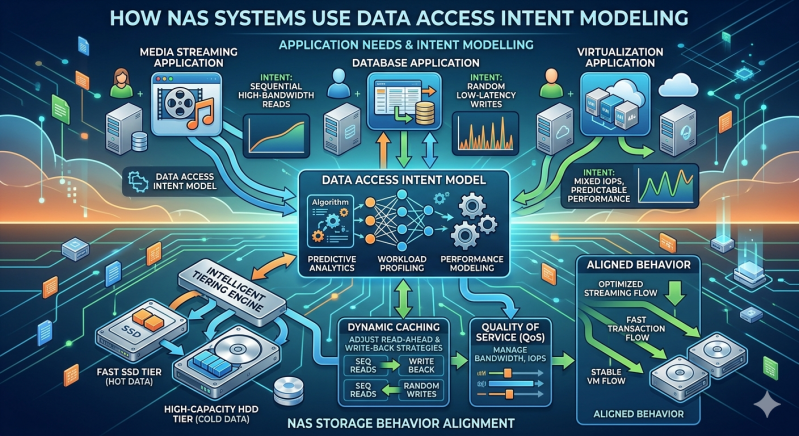
To address this latency gap, modern NAS Systems utilize a sophisticated computational framework known as Data Access Intent Modeling. This approach allows the storage controller to analyze incoming I/O streams in real-time and predict future data requests before the application explicitly asks for them. By understanding the underlying behavior of the application, administrators can configure their infrastructure to align storage behavior precisely with application needs. This alignment ensures high throughput, low latency, and efficient resource allocation across the entire storage fabric.
The Challenge of Unpredictable Application Workloads
Enterprise applications exhibit a wide variety of access patterns. A database might generate highly randomized read and write requests, whereas a media streaming server generates sequential, large-block reads. Legacy NAS solutions typically rely on rigid caching algorithms, such as Least Recently Used (LRU) or First-In-First-Out (FIFO). These deterministic algorithms fail to account for the dynamic nature of modern workloads.
When an application changes its behavior mid-operation, traditional NAS solutions experience cache misses, forcing the system to retrieve data from slower backend disk tiers. This architectural bottleneck directly degrades application performance. The resulting latency limits the number of transactions a database can process per second and causes buffering in streaming applications, proving that static caching models are insufficient for modern enterprise requirements.
Understanding Data Access Intent Modeling
Data Access Intent Modeling represents a paradigm shift in how NAS Systems process application I/O. Instead of treating each read or write request as an isolated event, the storage controller utilizes machine learning heuristics to identify sequential streams, strided access patterns, and complex randomized clusters.
The intent model continuously monitors metadata, such as file block offsets, request sizes, and access frequencies. Once the NAS Systems detect a recognizable pattern, the controller proactively adjusts its cache management and tiering algorithms. If the model detects a sequential read pattern, it triggers aggressive read-ahead prefetching, loading the upcoming data blocks into high-speed NVMe cache before the application requests them.
Aligning Storage Behavior with Application Needs
The primary objective of Data Access Intent Modeling is to dynamically tune the storage environment. Modern NAS solutions implement intent modeling to bridge the gap between application requirements and hardware capabilities.
For instance, virtualization environments often suffer from the I/O blender effect, where hypervisors multiplex multiple virtual machine storage requests into a heavily randomized stream. Advanced NAS solutions use intent modeling to demultiplex this stream. The storage controller identifies the individual I/O threads of each virtual machine and applies specific caching policies to each thread. This systematic alignment ensures that critical database queries receive priority caching, while lower-priority background tasks are directed to high-capacity, lower-cost storage tiers.
The Role of Intent Modeling in NAS Backup
Data protection is a critical component of enterprise storage architecture. Executing a comprehensive NAS Backup often strains the storage network, as the backup software must scan and transfer millions of files. Data Access Intent Modeling significantly improves the efficiency of NAS Backup operations.
During a backup window, the intent model recognizes the specific sequential read patterns generated by the backup application. In response, the NAS Systems allocate dedicated cache segments specifically for the NAS Backup process, preventing the backup from flushing critical application data from the primary cache. Furthermore, by predicting the trajectory of the NAS Backup read requests, the storage controller can pre-fetch data sequentially from high-capacity drives, ensuring the backup server receives a continuous, high-throughput stream. This intelligent resource allocation reduces backup windows and minimizes the performance impact on production applications.
Architectural Considerations for Intent-Driven Storage
Deploying intent-driven infrastructure requires a systematic evaluation of existing network and storage topologies. Administrators evaluating new NAS solutions must consider the computational overhead required to maintain real-time intent models. Analyzing millions of I/O operations per second demands robust storage controllers equipped with multi-core processors and substantial dynamic random-access memory (DRAM).
Furthermore, the effectiveness of Data Access Intent Modeling relies heavily on the integration between the storage array and the network protocol. File-sharing protocols such as NFSv4 and SMB3 provide rich metadata that advanced NAS solutions utilize to refine their predictive algorithms. Organizations must ensure their network architecture supports high-bandwidth, low-latency connections to fully realize the benefits of intent-driven caching and tiering. Proper implementation guarantees that standard application data serving and intensive background processes operate harmoniously on a unified hardware platform.
Security and Compliance within Predictive Frameworks
Beyond performance optimization, intent modeling provides secondary benefits for data security and compliance monitoring. Because the predictive algorithms continuously analyze I/O patterns to optimize caching, they inherently establish a baseline of normal application behavior. Advanced NAS solutions can leverage this baseline to detect anomalous access patterns indicative of a cybersecurity threat.
For example, if a standard application suddenly begins executing rapid, randomized read and encrypt operations across thousands of files, the intent model flags this deviation. While the primary function of the model is performance alignment, this behavioral analysis acts as an early warning system against external threats. Consequently, integrating predictive models fortifies both the operational efficiency of the applications and the integrity of the subsequent NAS Backup repositories, ensuring that compromised data is isolated before it propagates through the enterprise storage environment.
Future-Proofing Enterprise Storage Architecture
The integration of Data Access Intent Modeling fundamentally changes how storage networks interact with enterprise applications. By transitioning from reactive caching to proactive prediction, modern NAS Systems provide the precise performance characteristics required by complex, data-intensive workloads. As machine learning algorithms become more sophisticated, these NAS solutions will continue to improve their predictive accuracy, resulting in lower latency and higher overall throughput. Organizations that adopt intent-driven storage architectures will benefit from highly optimized environments, ensuring reliable application performance and highly efficient NAS Backup operations for years to come.
Add comment
Comments