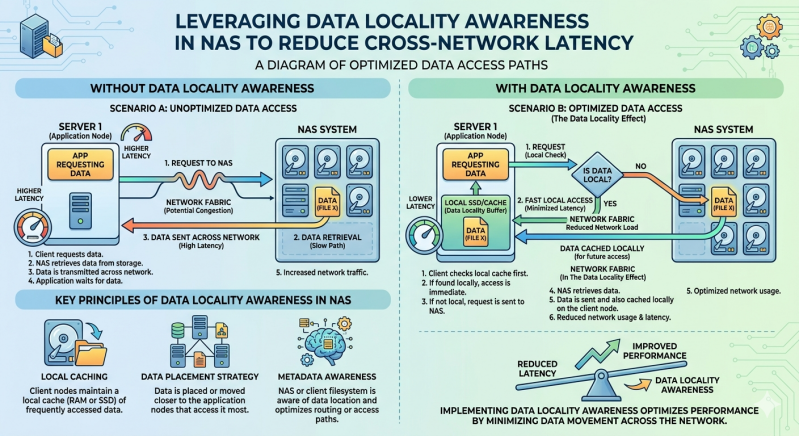
Latency remains a critical bottleneck in modern data center environments. As computational workloads grow in complexity, the distance data must travel between physical storage arrays and computing nodes directly impacts application performance. When systems process massive volumes of information, even microsecond delays compound, degrading throughput and causing system inefficiencies.
To resolve these bottlenecks, system architects must look beyond simple bandwidth upgrades. Increasing pipeline capacity does not alter the fundamental laws of physics dictating data transit times. Instead, the solution lies in optimizing the spatial relationship between processing units and data repositories.
This optimization relies heavily on data locality awareness. By intelligently managing where data resides relative to where it is processed, IT administrators can significantly mitigate the effects of cross-network latency. Network Attached Storage systems equipped with these locality-aware protocols represent a structural shift in how organizations handle high-demand data pipelines.
The Mechanics of Cross-Network Latency
Before analyzing the solution, it is necessary to examine the problem of cross-network latency. Latency is the total time it takes for a data packet to travel from its source to its destination. In traditional computing environments, storage and compute functions are often siloed. A server requesting data must send a query across multiple network switches, routers, and fabric interconnects.
Each hop introduces a processing delay. Furthermore, network congestion, protocol overhead, and physical cable length add cumulative fractions of a millisecond to the round trip. For standard file retrieval, this delay goes unnoticed. However, for high-frequency trading algorithms, real-time analytics, and virtual machine migrations, cross-network latency severely restricts operational capacity.
Organizations frequently deploy Enterprise NAS Storage solutions to centralize file sharing and data management. Without locality awareness, these centralized repositories force all compute nodes to pull data across the core network fabric. This creates a highly congested central uplink, limiting the overall scalability of the infrastructure.
Defining Data Locality Awareness
Data locality awareness is a system architecture principle that prioritizes storing data as physically or logically close to the computing resources that need it as possible. When an infrastructure is locality-aware, the management software actively monitors compute workloads and dynamically shifts data blocks to storage nodes operating on or near the requesting servers.
This principle minimizes the number of network hops required for read and write operations. If an application requires access to a specific database, a locality-aware system ensures that the data volume hosting that database is mounted on a Network Attached Storage node residing in the same server rack, or even on the same physical host machine.
By shrinking the physical transit distance, administrators achieve immediate latency reductions. The data bypasses the core network switches entirely, traveling only across high-speed top-of-rack switches or internal system buses.
Locality in Network Attached Storage
Modern Network Attached Storage architectures have evolved significantly from their origins as simple, centralized file servers. Today, distributed, scale-out NAS solutions utilize clustered file systems that span multiple physical nodes. This distributed nature is what makes data locality awareness highly effective.
When a scale-out Network Attached Storage cluster receives a write request, the file system algorithm determines the optimal node for placement. A locality-aware algorithm factoring in compute topologies will place that data block on the NAS node closest to the application server generating the data.
For read operations, if a virtual machine migrates from one host to another to balance compute loads, advanced Network Attached Storage protocols can detect this movement. The storage system will subsequently migrate the underlying data blocks to the storage node nearest the new compute host. This automated, background migration ensures that cross-network latency remains consistently low, regardless of dynamic changes in the compute environment.
Advantages for Enterprise Infrastructures
Deploying locality-aware architectures provides several measurable technical advantages for large-scale operations. Chief among these is the preservation of core network bandwidth. Because Enterprise NAS Storage nodes serve data to localized compute hosts, east-west traffic across the central network spine drops significantly.
This bandwidth preservation allows the core network to handle other critical operations, such as external client requests and wide-area network replication, without dropping packets due to congestion. Consequently, overall system reliability improves alongside performance.
Additionally, Enterprise NAS Storage systems utilizing data locality significantly boost input/output operations per second (IOPS). Applications spend less time waiting for I/O acknowledgments, which translates directly to faster database queries, accelerated machine learning model training, and smoother virtual desktop infrastructure deployments.
Cost efficiency also plays a vital role. By maximizing the throughput of existing network hardware through locality optimization, organizations can defer expensive upgrades to higher-bandwidth core switches. The Enterprise NAS Storage effectively extracts maximum value from the current infrastructure layout.
Optimizing Workload Distribution
To fully leverage these capabilities, IT departments must align their compute virtualization layers with their storage configurations. Hypervisors must be configured to communicate workload placement to the storage controllers. This integration allows the Enterprise NAS Storage system to maintain an accurate topological map of the environment.
System administrators should also implement tiering policies alongside data locality. Frequently accessed "hot" data should be kept on fast NVMe or SSD tiers within the localized Network Attached Storage nodes. Infrequently accessed "cold" data can be offloaded to centralized, high-capacity spinning disks, as the latency penalty for cold data retrieval is generally acceptable.
This multi-layered approach ensures that high-priority applications always experience the lowest possible latency, while storage costs remain carefully controlled. The intelligence embedded in the storage controller handles this continuous balancing act, operating seamlessly beneath the application layer.
Future-Proofing the Data Center
As data generation continues to scale exponentially, the physical limitations of network transit will become an increasingly prominent hurdle. Building architectures that respect and optimize for physical data proximity is no longer an optional tuning parameter; it is a fundamental design requirement.
By implementing Network Attached Storage systems that prioritize data locality awareness, engineering teams create highly resilient, low-latency environments capable of supporting the next generation of computational workloads. This strategic alignment of compute and storage resources ensures that the infrastructure will scale efficiently, maintaining peak performance without saturating the underlying network fabric.
Add comment
Comments