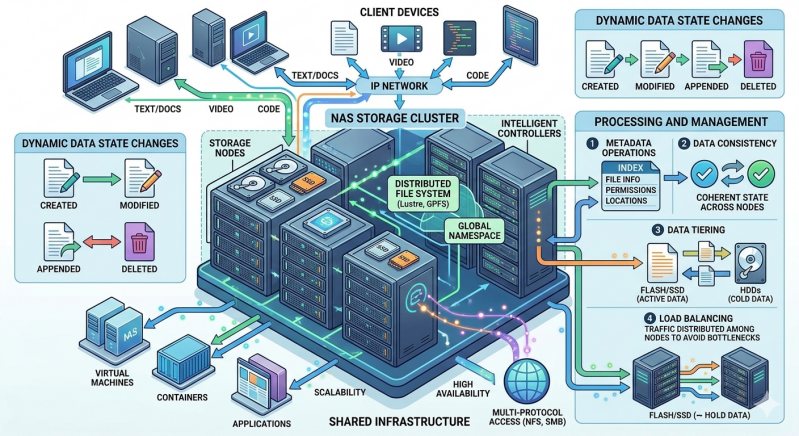
Dynamic data state changes within shared infrastructure present complex engineering challenges for systems administrators and network architects. When multiple clients access, modify, and commit data concurrently, the underlying architecture must guarantee absolute data integrity, metadata consistency, and operational availability. Network Attached storage protocols are specifically designed to arbitrate these concurrent operations, ensuring that state changes are accurately reflected across the entire network topology.
Understanding the internal mechanics of these transactions requires a systematic examination of file-level protocols, concurrency controls, and cache coherency mechanisms. By analyzing how modern architectures process transactional requests, enterprise architects can better design topologies that prevent data corruption and latency bottlenecks. This technical analysis explains the precise methodologies NAS storage solutions utilize to process dynamic data state changes across distributed and shared environments.
The Architectural Foundation of Network Attached Storage
At its core, Network Attached storage provides file-level data access to a heterogeneous group of clients on a local area network (LAN) or wide area network (WAN). Unlike block-level storage area networks (SAN), which manage raw storage volumes, NAS operates via high-level file system protocols. This architectural distinction dictates how state changes are processed.
When a client application initiates a write operation, it does not interact directly with the physical disk sectors. Instead, it sends a file-level modification request through the network stack. The operating system running on the storage appliance intercepts this request, translates it into block-level operations, and executes the physical write. During this sequence, NAS storage solutions must continuously update the file metadata—such as modification timestamps, access permissions, and file size allocations—and broadcast these state changes to all other connected nodes.
Mechanisms for Managing Dynamic Data State Changes
The integrity of a shared file system depends entirely on how it handles simultaneous modification requests. If two clients attempt to alter the same file sector simultaneously, the system must enforce strict operational sequencing.
File Locking and Concurrency Control
To prevent race conditions, NAS storage solutions implement sophisticated file locking mechanisms. When a client requests write access to a specific file, the system issues a lock. This lock can be exclusive, preventing any other user from reading or writing the file, or it can be a shared lock, which allows read-only access while the modification is in progress.
Advanced Network Attached storage architectures support byte-range locking. Rather than locking the entire file, byte-range locking restricts access only to the specific data blocks being modified. This granularity significantly improves concurrency, allowing multiple users to edit different sections of a large database or complex document simultaneously without triggering access violations.
Cache Coherency and Metadata Synchronization
Client-side caching drastically improves read/write latency. However, it introduces severe complications for dynamic data state changes. If a client caches a file and another client modifies the master copy on the server, the first client's cache becomes stale.
To resolve this, Network Attached storage protocols utilize cache coherency algorithms. When a state change occurs, the storage controller sends an invalidation message to all clients holding a cached version of that file. The clients are then forced to flush their localized caches and fetch the updated blocks from the central repository. This systematic synchronization ensures that all nodes operate on the most current data state, maintaining absolute fidelity across the shared infrastructure.
Protocol-Level State Management
The specific methods used to process data changes depend heavily on the file-sharing protocols configured within the environment. The two dominant protocols handle state changes using distinctly different paradigms.
Network File System (NFS) Dynamics
In UNIX and Linux environments, the Network File System (NFS) protocol dictates storage interactions. Early versions of NFS were stateless, meaning the server retained no information about client activities between requests. Every read or write operation had to contain all necessary authentication and file positioning data.
Modern NAS storage solutions utilizing NFSv4 operate as stateful architectures. The server explicitly tracks open files, file locks, and client leases. When a dynamic data state change is initiated, NFSv4 manages the transition using compound remote procedure calls (RPCs). This reduces network overhead by bundling operations—such as opening a file, writing data, and closing the file—into a single transmission.
Server Message Block (SMB) Processing
Windows-centric environments rely on the Server Message Block (SMB) protocol. SMB has always been a stateful protocol, deeply integrated with the Windows file locking semantics. To optimize dynamic changes, SMB utilizes a feature known as opportunistic locks (oplocks), or in newer iterations, caching leases.
When an SMB client accesses a file, it requests a lease from the server. If no other client is using the file, the server grants an exclusive lease, allowing the client to aggressively cache reads and writes locally. If a second client attempts to access the same file, the server revokes the exclusive lease, forcing the first client to flush its modified data back to the Network Attached storage array before the second client's request is processed.
Performance Optimization in High-Density Environments
Processing thousands of state changes per second generates massive computational overhead. To maintain throughput, enterprise-grade NAS storage solutions deploy non-volatile random-access memory (NVRAM).
When a client transmits a write request, the storage controller initially writes the data to the NVRAM rather than the physical hard drives. Because NVRAM operates at memory speeds, the server can immediately acknowledge the write as complete, drastically reducing client-side latency. The system then asynchronously flushes the data from the NVRAM to the physical disk array in the background. If a power failure occurs before the data reaches the disks, the battery-backed NVRAM retains the state change, committing it to the drives once power is restored.
Frequently Asked Questions
How do NAS storage solutions prevent data corruption during simultaneous writes?
These systems utilize strict concurrency controls, such as exclusive file locking and byte-range locking. These mechanisms ensure that only one client can modify a specific data block at any given microsecond, preventing overlapping writes that lead to logical corruption.
What happens when a client disconnects during a data state change?
Stateful protocols like NFSv4 and SMB monitor client connections using network heartbeats and lease timeouts. If a client drops offline during a transaction, the server automatically releases the locks held by that client and rolls back incomplete operations to the last known good state.
Can Network Attached storage handle transactional database workloads?
While traditional architectures were optimized for sequential file access, modern high-performance systems equipped with all-flash arrays and NVRAM caching are fully capable of processing the high-IOPS, random-write workloads generated by transactional databases.
Advanced Data Integrity Across Shared Infrastructure
The processing of dynamic data state changes requires an intricate orchestration of network protocols, locking semantics, and cache coherency rules. As enterprise workloads become more distributed and reliant on simultaneous multi-client access, the demands placed on storage arrays will continue to scale.
By implementing sophisticated stateful protocols and hardware-accelerated caching mechanisms, modern NAS storage solutions ensure that every modification is accurately recorded, synchronized, and protected. For systems architects, understanding these underlying methodologies is a necessary prerequisite for deploying Network Attached storage infrastructure that is both highly available and systematically resilient against data degradation.
Add comment
Comments