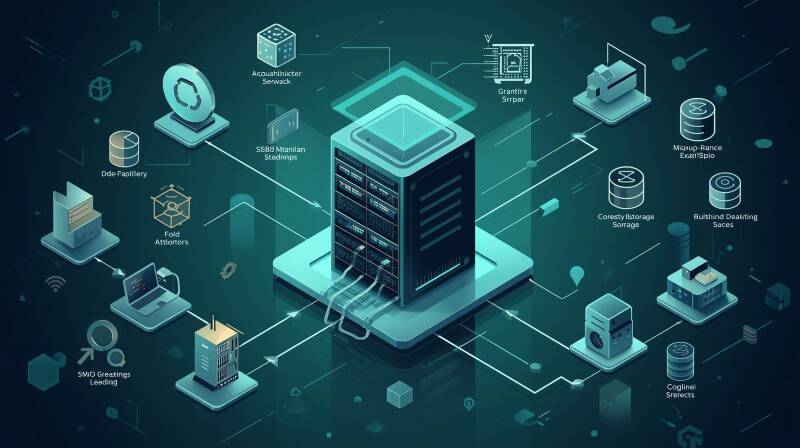
Enterprise development environments generate massive volumes of data every single day. Continuous integration and continuous deployment (CI/CD) pipelines produce a constant stream of build artifacts, including compiled binaries, container images, and extensive test logs. Managing this output requires robust infrastructure. If the underlying storage architecture fails to keep pace with the development cycle, the entire pipeline experiences latency, leading to delayed deployments and reduced engineering productivity.
Network-Attached Storage provides a centralized, highly accessible repository that meets the rigorous demands of large-scale DevOps operations. Implementing dedicated NAS solutions allows enterprise teams to standardize their storage protocols, ensure high availability, and maintain strict security controls over their intellectual property.
This post details how organizations can leverage NAS infrastructure to manage build artifacts, scale their pipeline storage, and protect critical development data from external threats.
The Bottleneck of DevOps Data Generation
Modern software development relies on automation. Every code commit triggers a series of automated builds and tests. These processes generate significant amounts of data. A large enterprise might execute thousands of builds daily, with each build producing gigabytes of artifacts.
When developers use localized or fragmented storage systems, pipelines inevitably slow down. Build runners spend excessive time fetching dependencies or writing outputs to slow disks. Furthermore, fragmented storage complicates artifact lifecycle management. Operations teams struggle to implement unified retention policies, leading to bloated storage arrays filled with outdated, unnecessary build files. Deploying NAS solutions provides centralized, high-performance storage that simplifies artifact management, improves pipeline speed, and ensures consistent retention policies across the organization.
Centralizing this data is a technical necessity. A unified storage tier must provide high throughput to support concurrent read and write operations from multiple build agents simultaneously.
Scaling Pipelines with NAS Storage
Enterprise NAS Storage addresses the specific bottlenecks found in high-velocity development environments. By decoupling storage from the compute nodes that run the CI/CD pipelines, organizations gain significant flexibility and performance enhancements.
High Throughput and Concurrency
Build nodes require rapid access to shared dependencies and caching layers. NAS systems utilize advanced file-sharing protocols, such as NFSv4 and SMB3, to deliver high-speed access to thousands of concurrent connections. This architecture ensures that when multiple pipelines request the same base container image or library, the storage array serves the data without queuing delays. Advanced NAS hardware also employs NVMe caching and all-flash arrays to further reduce latency during critical build phases.
Simplified Artifact Lifecycle Management
Managing the lifecycle of build artifacts is highly complex without a centralized system. NAS solutions offer native integrations with policy-driven data management tools. Administrators can define automated rules to migrate older, stable release artifacts to lower-cost storage tiers while keeping active branch builds on high-performance flash. Automated expiration policies can also purge ephemeral test builds after a specified timeframe, continuously freeing up capacity for new operations.
Securing the Development Pipeline
As source code and compiled binaries represent a company's most valuable intellectual property, securing the CI/CD pipeline is critical. Attackers increasingly target development environments to inject malicious code or disrupt operations.
Mitigating NAS Appliances Ransomware
Ransomware operators recognize that halting a company's development pipeline can force quick payouts. Defending against NAS appliances ransomware requires a multi-layered approach to storage security. Modern NAS operating systems incorporate native protective features to detect and neutralize unauthorized encryption attempts.
Administrators should implement immutable snapshots. These read-only copies of the file system cannot be altered or deleted by any user, including administrators, for a predetermined period. If a ransomware variant compromises a build node and attempts to encrypt the mapped NAS drives, the storage array preserves the clean, immutable snapshots. Operations teams can then instantly revert the file system to its pre-attack state, minimizing downtime and data loss.
Additionally, behavioral analytics embedded within the storage infrastructure monitor file access patterns. If the system detects a rapid, anomalous sequence of file modifications typical of a ransomware infection, it can automatically sever the compromised host's connection and alert the security operations center.
Frequently Asked Questions
What makes NAS better than object storage for CI/CD pipelines?
While object storage excels at long-term archiving, NAS provides the low-latency, file-level access required by traditional build tools and compilers. Many legacy and enterprise build systems expect a standard POSIX-compliant file system to read dependencies and write outputs efficiently.
How do you calculate storage requirements for build artifacts?
Storage capacity planning requires analyzing the average size of a complete build, the number of builds executed per day, and the organization's retention policy. For example, retaining 100 daily builds of 5GB each for 30 days requires 15TB of usable capacity, excluding RAID overhead and snapshot reserves.
Can NAS infrastructure support distributed, multi-region development teams?
Yes. Enterprise NAS storage platforms offer asynchronous and synchronous replication features. These capabilities allow organizations to mirror repository data and cached artifacts across multiple geographic data centers, providing low-latency access to regional development teams while ensuring disaster recovery readiness.
Strategic Next Steps for Enterprise Storage
Deploying an optimized storage architecture directly impacts the efficiency of the software development lifecycle. Organizations must evaluate their current pipeline bottlenecks, assess the volume of their build artifacts, and implement storage systems capable of handling concurrent, high-throughput demands.
Audit your current CI/CD storage infrastructure to identify latency issues and security vulnerabilities. Review your retention policies and ensure that immutable snapshots are active to defend against evolving cyber threats. By treating pipeline storage as a critical enterprise asset, engineering teams can maintain rapid deployment schedules and secure their development operations.
Add comment
Comments