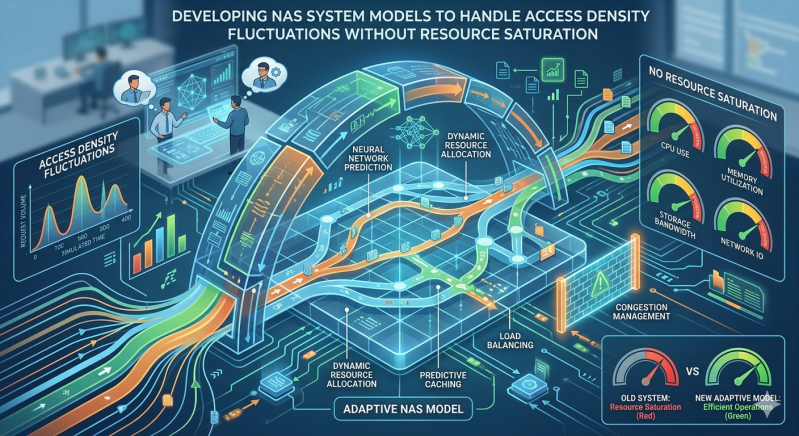
Modern data environments are no longer defined by steady, predictable workloads. Instead, they are shaped by rapid shifts in how data is accessed, processed, and shared. Applications generate bursts of activity, users interact with data in unpredictable ways, and automated systems continuously modify file states. These dynamics create what is known as access density fluctuations—periods where specific files, directories, or storage segments experience sudden spikes in activity.
For any NAS system, handling these fluctuations efficiently is critical. When access density increases beyond what the system can manage, it leads to resource saturation—where CPU, memory, I/O, or network bandwidth becomes overwhelmed. The result is degraded performance, increased latency, and reduced throughput. To prevent this, modern storage architectures must evolve beyond static models and adopt adaptive, intelligent frameworks.
Understanding Access Density Fluctuations
Access density refers to how frequently data is accessed within a specific time frame. In stable environments, access patterns remain relatively consistent, allowing systems to optimize for predictable workloads. However, in real-world scenarios, access density is rarely uniform.
Examples include:
- A dataset becoming highly active during analytics processing
- Multiple users accessing the same files simultaneously
- Automated processes triggering bursts of metadata operations
- Applications shifting from read-heavy to write-heavy workloads
These fluctuations create uneven demand across the storage infrastructure. Without proper handling, certain components of the NAS storage environment become overloaded while others remain underutilized.
The Challenge of Resource Saturation
Resource saturation occurs when system components reach their operational limits. In a NAS system, this can manifest in several ways:
- CPU spikes due to excessive metadata processing
- Memory pressure from caching high-frequency data
- I/O bottlenecks caused by concentrated access requests
- Network congestion in distributed storage environments
When saturation occurs, the system struggles to maintain performance consistency. Requests are delayed, queues build up, and overall efficiency declines.
Moving Beyond Static System Models
Traditional storage architectures rely on fixed configurations and predefined allocation strategies. While effective for predictable workloads, these models fail under dynamic conditions.
To address access density fluctuations, modern NAS storage systems must adopt flexible, adaptive models that can respond to changing conditions in real time. These models focus on:
- Dynamic resource allocation
- Real-time workload analysis
- Intelligent request distribution
- Continuous performance optimization
By shifting from static to adaptive models, the system can handle variability without reaching saturation.
Building Adaptive NAS System Models
Developing effective models for handling access density fluctuations requires a combination of monitoring, analysis, and automated response mechanisms.
1. Real-Time Workload Monitoring
Continuous monitoring is the foundation of any adaptive system. By tracking access frequency, concurrency levels, and resource utilization, the NAS system gains visibility into emerging patterns.
This allows the system to:
- Detect hotspots before they escalate
- Identify underutilized resources
- Adjust operations proactively
2. Intelligent Load Distribution
Rather than allowing workloads to concentrate on specific nodes or storage segments, modern models distribute requests more evenly.
This includes:
- Redirecting requests to less busy nodes
- Balancing read and write operations
- Preventing localized resource exhaustion
In distributed NAS storage environments, this approach is essential for maintaining stability.
3. Dynamic Caching Mechanisms
Caching plays a critical role in managing access density. However, static caching strategies are insufficient when access patterns change rapidly.
Adaptive caching ensures that:
- Frequently accessed data remains in high-speed storage
- Cache eviction policies adjust based on real-time usage
- Memory resources are used efficiently
This reduces the load on underlying storage layers and improves response times.
4. Metadata Optimization
Metadata operations often become a bottleneck during high-density access periods. Efficient handling of metadata is crucial for preventing saturation.
Modern approaches include:
- Parallelizing metadata operations
- Distributing metadata across nodes
- Reducing dependency on centralized structures
These techniques enable the NAS system to handle high volumes of requests without delays.
Preventing Bottlenecks Before They Form
One of the key advantages of adaptive models is their ability to prevent bottlenecks rather than simply reacting to them. By analyzing trends and predicting workload behavior, the system can take preemptive actions.
For example:
- Preloading frequently accessed data into cache
- Adjusting resource allocation ahead of peak usage
- Redirecting workloads before saturation occurs
This proactive approach ensures smoother performance and reduces the risk of sudden slowdowns.
Balancing Performance and Resource Efficiency
Handling access density fluctuations is not just about maximizing performance—it is also about using resources efficiently. Over-provisioning resources can prevent saturation but leads to increased costs and inefficiency.
A well-designed NAS storage model achieves balance by:
- Allocating resources based on actual demand
- Scaling operations dynamically
- Avoiding unnecessary data movement
This ensures that the system remains both high-performing and cost-effective.
Supporting High-Concurrency Environments
Concurrency is a major driver of access density fluctuations. In environments where multiple users and applications interact with data simultaneously, the system must handle overlapping requests efficiently.
Advanced NAS system models support concurrency by:
- Reducing lock contention
- Allowing parallel processing of requests
- Prioritizing critical operations
These capabilities ensure that performance remains stable even under heavy load.
The Role of Predictive Intelligence
As storage systems evolve, predictive intelligence is becoming a key component of adaptive models. By analyzing historical data and identifying patterns, systems can anticipate future workload changes.
This enables:
- Early detection of potential hotspots
- Automated adjustment of system behavior
- Continuous optimization without manual intervention
In modern NAS storage environments, predictive capabilities significantly enhance resilience and efficiency.
Future Directions in NAS System Design
The future of storage architecture lies in self-optimizing systems that can adapt to changing conditions autonomously. Emerging trends include:
- AI-driven workload analysis
- Autonomous resource allocation
- Real-time anomaly detection
- Fully distributed system coordination
These innovations will further improve the ability of storage systems to handle access density fluctuations without resource saturation.
Conclusion
Access density fluctuations are an inherent challenge in modern data environments. As workloads become more dynamic and unpredictable, the risk of resource saturation increases.
By developing adaptive models that incorporate real-time monitoring, intelligent load distribution, and predictive analysis, a NAS system can effectively manage these fluctuations. Modern NAS storage solutions are no longer just repositories for data—they are intelligent systems capable of evolving alongside the workloads they support.
Ultimately, the ability to handle variability without compromising performance is what defines the next generation of storage architectures.
Add comment
Comments